The Significance of Trees in Lakota Thought

By Andrew Smith

The Lakota were the last group of native peoples to inhabit the Black Hills area before the arrival of the white men in the 19th century. Although much traditional cultural knowledge was lost or deliberately destroyed in the generations of conflict with white civilization, much was passed down and is still alive within the Lakota community today. The ideas presented in this chapter have been gleaned from conversations with several knowedgeable Lakota men, and compiled from what I could find in books. It is by no means a comprehensive analysis of the subject, but I hope it will allow us to view the significance of trees from a perspective that is native to the Black Hills.

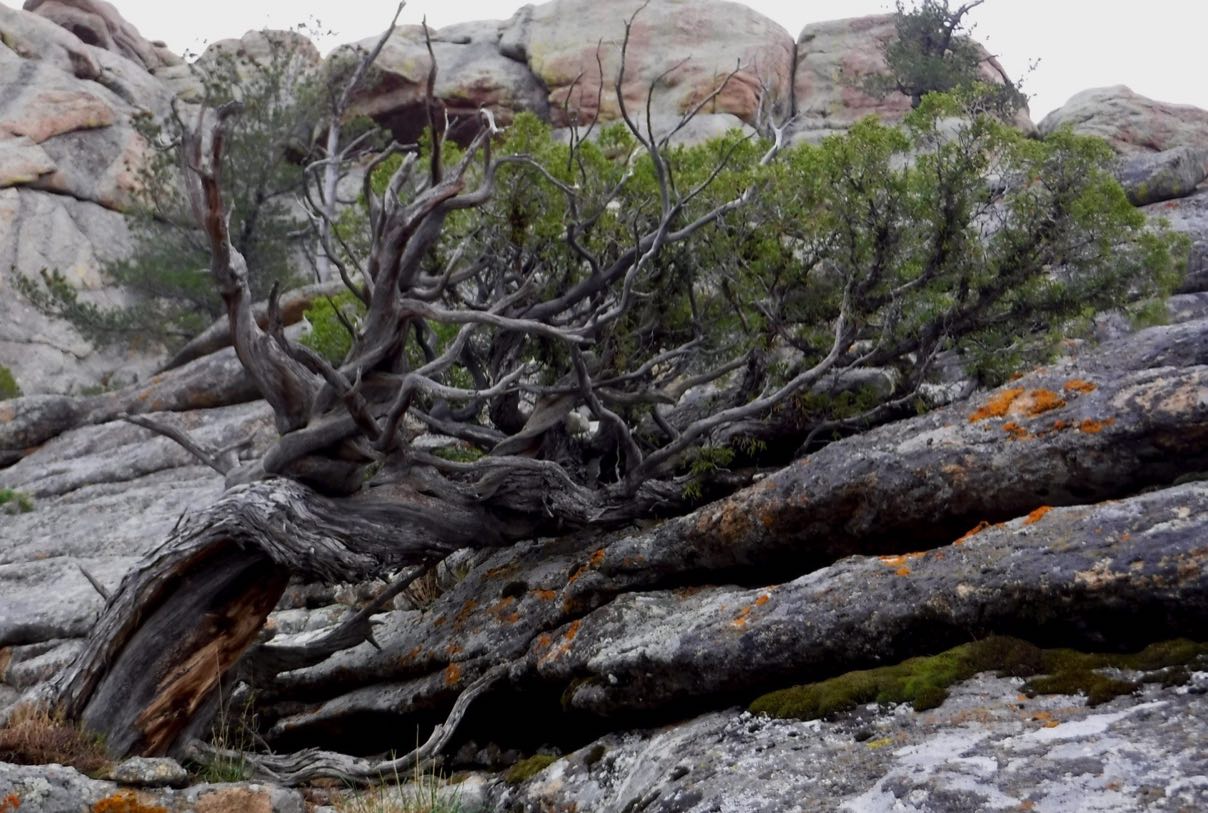
Dr. Art Zimiga has stated that the commonly used "Indian" name for the Black Hills, the Paha Sapa, was actually a translation into Lakota of the name early white missionaries gave the region - "The Black Hills." The Lakota themselves called the area "He Sapa", which could be translated as "Black Butte", but also as "Cedar (or conifer) Hills", or "Where The Cedars Are", though some sources dispute the latter translation. But inasmuch as the oldest living thing in the Black Hills, or South Dakota for that matter, is almost certainly a cedar (Rocky Mtn juniper) tree, it seems a wise choice of names.

Cedar and juniper trees themselves have sacred connotations going back many thousands of years and appearing in many diverse cultures. In the eastern U.S. the locations of old graveyards can sometimes be determined by the cedars that were planted there. In the second Book of Chronicles, Solomon built a temple for Yahweh. "The great hall he lined with juniper, which he overlaid with gold..."(3:5) Nearly everyone has heard of the Cedars of Lebanon. The Lakota may have had similar sacred associations with these trees. Lame Deer has stated that cedar dust is often thrown on the fire in sweat lodges and other ceremonies, because it's pleasant scent purifies the air. Ben Rhod, a Native American archaeologist who practices traditional religion, says that the red cedar belongs to the Wakiyan, or Thunder Nation. For this reason, cedar staffs were sometimes carried as protection against lightning.

One thing that should not be overlooked is that the relationship the Lakota, or any native peoples, had with trees was primarily utilitarian. Trees provided a vast natural resource that offered the people an ever renewing source of fruits and nuts, firewood for warmth and cooking, medicines, wood for teepee poles, lances, war clubs, eating utensils, bows and arrows, toys and a thousand other uses, cool shade in the summer and a windbreak in the winter, as well as a living symbol of life's mysterious eternal cycle.

Lakota religion is much more individually oriented and much less dogmatic than Christianity. More emphasis is placed on personal visions and spiritual awareness, than on adhering to a socially accepted set of religious beliefs. Therefore, any symbol, such as a tree, will contain a multitude of meanings and relationships, some personal, and some common to the people as a whole, but all valid within the context of Lakota religion.

In the early 1930's the poet John G. Niedhardt met with the Lakota holy man Black Elk to record his life story and much of the sacred knowledge that he carried within him. In the book Black Elk Speaks, the old sage describes the sacred tree of his great vision, which he experienced when just a young boy.

"I looked ahead and saw the mountains there with rocks and forests in them, and from the mountains flashed all colors upwards to the heavens. Then I was standing on the highest mountain of them all, and round about me was the whole hoop of the world. And while I stood there I saw more than I can tell and I understood more than I saw; for I was seeing in a sacred manner the shapes of all things in the spirit, and the shape of all things as they must live together like one being. And I saw that the sacred hoop of my people was one of many hoops that made one circle, wide as daylight and as starlight, and in the center grew one mighty flowering tree to shelter all the children of one mother and one father. And I saw that it was holy."

The sacred tree is described again in Niedhardt's When The Tree Flowered. In this version the holy man Blue Spotted Horse is giving instructions to Eagle Voice, a young Lakota who is about to undertake a vision quest.

"...at the place whence comes the power to grow, a road begins, the good red road of spirit that all men should know; and it runs straight across the hoop of the world to the place whence comes the power of cleansing and healing, to the place of white hairs and cold and the cleansing of old age.

"And then there is a second road, the hard black road of difficulties that all men must travel. It begins at the place whence come the days of men, and it runs straight across the hoop of this world to the place where the sun goes down and all the days of men have gone and all their days shall go; far beyond is the other world, the world of spirit. It is a hard road to travel, a road of trouble and need. But where this black road of difficulties crosses the good red road of spirit at the center of the hoop of the world, that place is very holy, and there springs the Tree of Life. For those who look upon the Tree, it shall fill with leaves and bloom and singing birds; and it shall shield them as a prairie hen shields her chickens."

Here we have two descriptions of the Sacred Tree, the Tree of Life, which is an image that is common to all men, and cultures. It is an image whose significance has outlasted the centuries, and is still of vital importance to many native peoples today. The book The Sacred Tree, produced by the Four Worlds Development Project, tells the story of the Sacred Tree from a native American perspective, and then uses the healing images to outline a path of wholeness and spirituality.

In Black Elk Speaks, the sage describes the tree of his vision as a "waga chan, the rustling tree," also known as a cottonwood. Cottonwood trees have many sacred associations with the Lakota, the most obvious being their use in the sundance ceremony. According to Dr. Zimiga, the cottonwood tree is used in the sundance ceremony because the pith appears as a five-pointed star in cross-section, after the tree is cut. In effect, the cottonwood tree contains a sign from the star nations inside it.

Eagle Voice describes the sundance tree as the chan wakan, the holy tree, and the Ever-Living One. Two men and two women, all known for their virtue and generosity, were chosen to search for the chan wakan. The cottonwood tree had to be tall, straight, and slender, with a small fork near the top. After the tree was selected and cut down it was to remain untouched by human hands, for it was sacred.

The dancing area was arranged as a sacred hoop around the tree. Before the tree was raised the people made offerings to it. It was painted red, a sacred color, and then raised into place. The Sacred Tree was planted.

During the sundance the dancers pierce their bodies with buffalo hide thongs attached to the holy tree. The dance is a grueling test of their commitment, but if they are successful they will be blessed with a vision. Their suffering and sacrifice is given as an offering to the Creator, and the offering is given through the holy tree.

There is a common thread to these rituals, that transcends time and culture, and is probably older than civilization itself. Consider that Christ's sacrifice and suffering also took place upon a tree, a tree shaped into a cross. "...where this black road of difficulties crosses the good red road of spirit at the center of the hoop of the world, that place is very holy..."

The religious connotations of trees to the Lakota and other Plains Indians is something that has been kept alive throughout the centuries, and is still with us today. At Bear Butte, on the northeast corner of the Black Hills, Native Americans still tie prayer ribbons to trees as part of their religious practices. Years ago in Montana my wife and I came across an old ponderosa pine that was adorned with prayer ribbons. A nearby sign stated that the tree was over 400 years old and had been venerated for centuries by local Native Americans.

According to Ben Rhod, the prayer ribbons represent man's way of interacting with, and taking part in the prayers of the tree, which are always viewed as being in prayer in Native American culture.

"We as people should emulate the tree," he said. "A tree always holds its arms up to the sky. It's always in prayer. If we emulate the tree in our real lives we see how hard it is to stand with a prayer. I don't know of any Native American people who don't know that the trees are always praying-because they are wakan. Each tribe has their own way of expressing it, but it comes back to the same thing.

"We put prayer ribbons on trees because life is ongoing. The tree is growing, the tree is praying. The wind moves the prayer ribbons. The relationship between that movement and the movement of the earth is related to the wind. Life is moving. When it stops it's dead. And that tree is praying every day as it moves in the wind. When you put a prayer into that prayer ribbon, it spreads it all across the earth."

Trees are associated with myths of creation and origins in many cultures. One Plains Indian myth about the creation of Devil's Tower, a marvelous volcanic pillar with sacred connotations to the Lakota, has seven sisters being chased up an enormous tree by their brother, who'd been turned into a bear. The sisters escaped into the sky to become the stars of the big dipper, while the scored remains of the tree became Devil's Tower. Thus heaven and earth are linked through the story of a great, cosmic tree.

The idea that trees are beings in prayer, and that they serve as a link between heaven and earth, may shed some light on the practice of tree burials, which were practiced by the Lakota and other Great Plains peoples. Instead of burying their dead underground, the Lakota most commonly prepared the body for the journey to the other world, then wrapped it in a bundle, which was placed in a tree, or scaffold. There the body, cradled in the swaying tree branches, was offered to the wind, and sun, and sky, until it had all been returned, and nothing remained of it. Weathered old burial trees may still be found occasionally on the Great Plains today.

Dallas Chief Eagle is a modern Lakota who is is following a traditional spiritual path. Chief Eagle has spent much time thinking about the significance of the Sacred Tree, because trees played a prominent role in his personal vision, which susequently changed his life.
In his vision, Chief Eagle witnessed a black line with a row of little trees growing on it. The little trees were growing underneath some big trees, and were crying out to the big trees for a vision, and for their future. The little trees were influenced by the big trees.

"My dedication is to the little trees," says Chief Eagle. "My dedication is nurturing the Tree of Life. A dedication is a way of life, a discipline, a task. I've been on the dedication for seven years now, and my vision, and my dream, is still unfolding. It's not complete.

"My biggest concern right now is those little seedlings, so I work with the children. One of my focuses is alcohol and drug abuse, because it poisons those little trees.

"To heal the trees, to heal the Sacred Hoop, my dedication is that the children take care of their trees. We were all given that power -to take responsibility for all of our faculties -mind, body, heart and soul."

Chief Eagle teaches traditional hoop dancing to Lakota children as a way to help them regain and express their pride, confidence, and self-esteem. He has taken his vision of the crying little trees, and made it his life's work to heal them. He is taking his vision, and bringing it to life.
And it is no coincidence that the Lakota word for tree, cån, (pronounced chan) also means hoop. A tree and a hoop are the same thing. Both are expressions of the sacred center from which all life springs, and to which all life returns. A tree, or a hoop, is a symbol for the mystical unity where all things become one. A tree is a connecting link between all things, holding the opposites of creation together. Water from the ground becomes one with the fire of the sun within the life and body of the tree.

Cån gleska means "spotted tree," and refers to the Tree of Life. "There are all kinds of variations of the Tree," says Chief Eagle "that's why it's spotted. And there are all kinds of people. Gleska, the spots, refers to different cultures, different trees. It's a Tree of Life, or Hoop of Life, a sacred hoop.

"A hoop makes a cycle, and a tree makes a hoop when it goes through the seasons -winter, spring, summer, fall. A tree has roots in the earth, the female, but it reaches for the sky, the male. The balance is there. The middle of that tree is the middle of that hoop. And right at the center, at the pith, at the heartwood, is where those seedlings are. That's where change occurs. And we cannot fool those little trees."

In November of 1993 Chief Eagle, and a friend, and I went to visit some of the most ancient trees in the Black Hills. Our first stop was at Big Ed #1, a truly magnificent old ponderosa pine, with a height of 97 feet, a 35 inch diameter, and an age estimated at ±582 years.
Chief Eagle compared ancient trees to old men and women. Both are storehouses of experience that contain priceless knowledge. Where our elders contain the wisdom of a long life, and memories of people and events long gone by, ancient trees contain a detailed record of the environment, carefully encoded in their growth rings, and sometimes going back thousands of years.

"The old people, they have a memory," said Chief Eagle. "They have the experiences. A tree always grows from it's past -and so do we, always. But today we've forgotton about the elderly. We don't take care of them, but we forget that they were there all that time to take care of us.

"There's an emotional wisdom there," he said, placing his hand on the ancient ponderosa. "The only way that you can get that emotional wisdom is to find that balance, to tap into those elderlys."

Chief Eagle noted that Cån Gleska, the Tree of Life, was also a symbol for man's communion with the universe. The tree was an expression of the wholeness, the unity, where all life is one. Man can experience this unity through his feelings.

"Tiospaye means extended family," he said, "-the two legged, the four legged, the winged, and the rooted. These also make a hoop. For a Lakota man to act like an animal, to imitate an animal, was an honor, because we are related. And we all have feelings. We can't think alike, and we can't talk alike, but we have something in common -these feelings.

"You have to learn to stop thoughts, to let the mind shut down and the feelings take over. There's that power, that emotional communication going on, where we become one.
Chief Eagle laid his ear gently against the trunk of the mammoth old tree, and listened intently. The wind blew bitterly cold. After a few minutes he smiled and said, "the tree is talking to me."

He backed away so we could listen. I put my own ear against the trunk, not expecting to hear anything more than the wind in the branches. But what I heard was a soft musical tinkling, like wind chimes in a cool summers breeze. It was certainly no sound I would expect a tree to make. I stood back and looked at the old giant again, confronted with it's mystery.

"Maybe it was a squirrel," said Chief Eagle. "Or maybe there's a bird up there somewhere. We could try and explain it, but the fact is, what we heard was life going on. It's like a heartbeat, like the drums at a powwow -heartbeats. At the powwow we take our thinking caps off. It's all run on feeling. Feelings join us to Tiospaye, that Tree of Life, that hoop."


Back